
What Therapy is Really Like – 6 Common Therapy Myths Explained
NB: This is a revised version of an article published in NG Magazines across Nottinghamshire.
As a psychotherapist and EMDR therapist, I often meet people who’ve considered therapy for some time before getting in touch.
Usually, it’s not that people don’t want help but because common misconceptions can make the process of finding or engaging in therapy feel intimidating, uncomfortable, or even unnecessary.
Join me as I outline six myths I’ve come across and what therapy actually involves in practice.
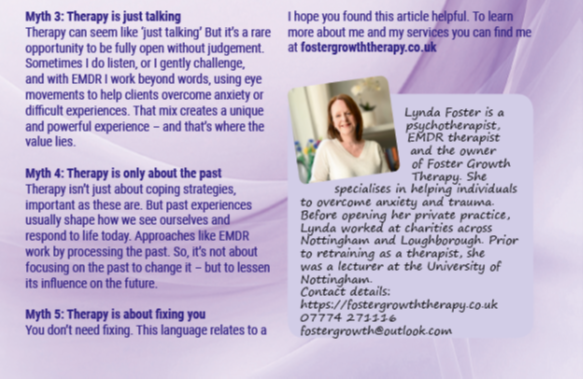
Article published in NG Magazine
Myth 1: Therapy is only for the mentally ill
It makes sense that some see therapy as treatment for illness – it’s often tied to GP referrals. But many clients have told me they delayed therapy, or feel uncomfortable because their problems don’t seem ‘bad enough’ to justify support. I hope to reassure you that your problems are just as important as anyone’s.
In reality, mental health’s a spectrum and people come to therapy for many reasons. I specialise in anxiety, low self-esteem, and helping clients to overcome difficult experiences.
So even if you’re functioning okay, therapy can still help you work through stuff that’s happened or just get to know yourself better.
Myth 2: Therapy is just listening and talking
Have you ever opened up to someone only to get cut off, given advice, or told to “just be positive”? We’ve all shared something important and been met with advice or clichés instead of real listening.
Therapy may seem like ‘just talking’. But how often do you have conversations where you can be vulnerable and open without worrying about being judged or shamed?
In my practice, I offer a working relationship where clients can feel heard and understood in a way they may not experience elsewhere. But finding a therapist you feel comfortable with is most key.
Myth 3: Therapy is passive
Some think that therapy is a very passive process that’s led by the therapist. But in reality, my clients work with me on planning the actions that we take to help them feel better.
Active therapy involves reflection to understand patterns and helping clients to develop skills that move them towards behavioural changes and growth.
EMDR therapy, is an active therapy I use to help many clients manage their emotions and understand experiences in a way that differs from talking. But not every therapeutic approach will be the right fit for every person.
Myth 4: Therapy is only about the past
Therapy is not just about the past. Healthier ways of coping in the present are really important and offering tools e.g. to help clients manage stress and anxiety is something I do regularly in my practice. But just doing that can be a bit like putting a sticking plaster over a wound because the wound still needs to heal.
Many people are surprised to discover their past could be shaping what they believe and how they behave today.
Approaches like EMDR work by gaining insight into and processing the past. So, it’s not about focusing on the past to change it – but to lessen its influence on the future.
I also debunk common myths about EMDR therapy here.
Myth 5: Therapy is about fixing you
In my experience I notice that many people arrive in therapy believing something is wrong with them. Often, they’ve spent years criticising themselves or feeling they should just ‘cope better.’
But what I see is that people struggle because of what’s happened to them in life. A loss, or a difficult relationship. In practice, therapy is rarely about ‘fixing’ you. It’s teamwork – combining knowledge of yourself with therapeutic judgment and wisdom to ease your struggles and find new ways forward.
Myth 6: Therapy is for the weak
This myth might be the most damaging. And as we live in a world of comparison, I often hear phrases like – “Others have it worse” or “You should be grateful.” In truth, privilege, gratitude, and struggle can co-exist.
You can ‘be positive’, thankful for what you have, get on with life while still facing problems or difficult feelings.
The reality is that is takes courage to face problems. Recognising that you need support is acknowledging that you’re human. And suffering sometimes is inherently human.
Finally…
Therapy isn’t just talking, listening, or dwelling on the past. And seeking therapy isn’t a sign of weakness or being ‘broken’. For many people, it’s a way to understand themselves better, overcome difficulties, and feel supported.
Lynda Foster is a psychotherapist, EMDR therapist and the owner of Foster Growth Therapy. She specialises in helping individuals to overcome anxiety and trauma. Before opening her private practice, Lynda worked at charities across Nottingham and Loughborough. Prior to retraining as a therapist, she was a lecturer at the University of Nottingham. Contact here.